
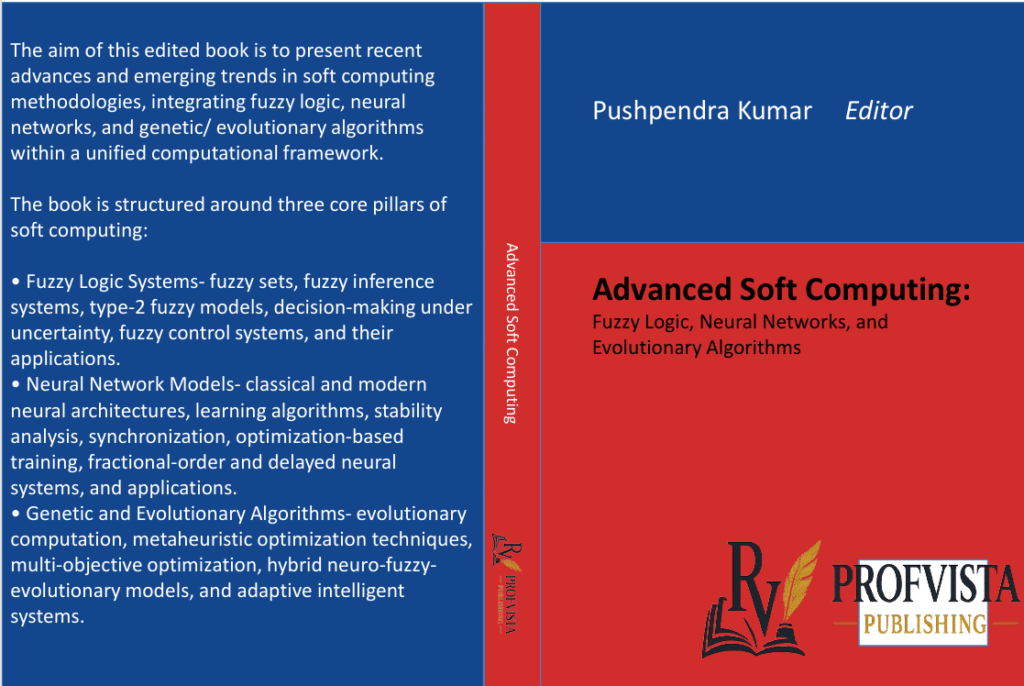
Book Details
Editor: Pushpendra Kumar
Publisher: ProfVista Publishing
Type: Edited Book
Status: Call for Chapters Open
About the Book
The aim of this edited book is to present recent advances and emerging trends in soft computing methodologies, integrating fuzzy logic, neural networks, and genetic/ evolutionary algorithms within a unified computational framework. Soft computing has evolved as a powerful paradigm for handling uncertainty, imprecision, nonlinearity, and complex optimization problems where traditional analytical approaches often fail.
This book brings together leading researchers and emerging scholars to explore both the theoretical foundations and practical implementations of soft computing techniques. It emphasizes rigorous mathematical analysis, algorithmic development, hybrid intelligent systems, and real-world data-driven modeling across science, engineering, and applied mathematics.
Scope/Topics
The book is structured around three core pillars of soft computing:
- Fuzzy Logic Systems– covering fuzzy sets, fuzzy inference systems, type-2 fuzzy models, decision-making under uncertainty, fuzzy control systems, and their applications in engineering and management sciences.
- Neural Network Models– including classical and modern neural architectures, learning algorithms, stability analysis, synchronization, optimization-based training, fractional-order and delayed neural systems, and applications in modeling biological, social, and technological processes.
- Genetic and Evolutionary Algorithms– focusing on evolutionary computation, metaheuristic optimization techniques, multi-objective optimization, hybrid neuro-fuzzy-evolutionary models, and adaptive intelligent systems.
Submission Details
📅 Deadline: 15 June, 2026
📧 Submission Email: Submit your chapter to the editor. Email: kumarsaraswatpk@gmail.com
📄 Format: Kindly collect the LaTeX / Word template from the editor. Email: kumarsaraswatpk@gmail.com
Plagiarism and AI Content Policy
All submitted chapters must be original and should not be under consideration elsewhere. The maximum allowed similarity index is 25% (excluding references and properly cited content). Additionally, AI-generated content should be limited to no more than 10%.
Authors are expected to ensure that their work maintains academic integrity, proper citations, and originality. Submissions that do not meet these criteria may be rejected without review.
Why Publish with ProfVista
Fast review process
ISBN assigned book
Global visibility
Academic recognition
👉 “Submit Your Chapter Now”
Email: kumarsaraswatpk@gmail.com (Prof. Pushpendra Kumar)